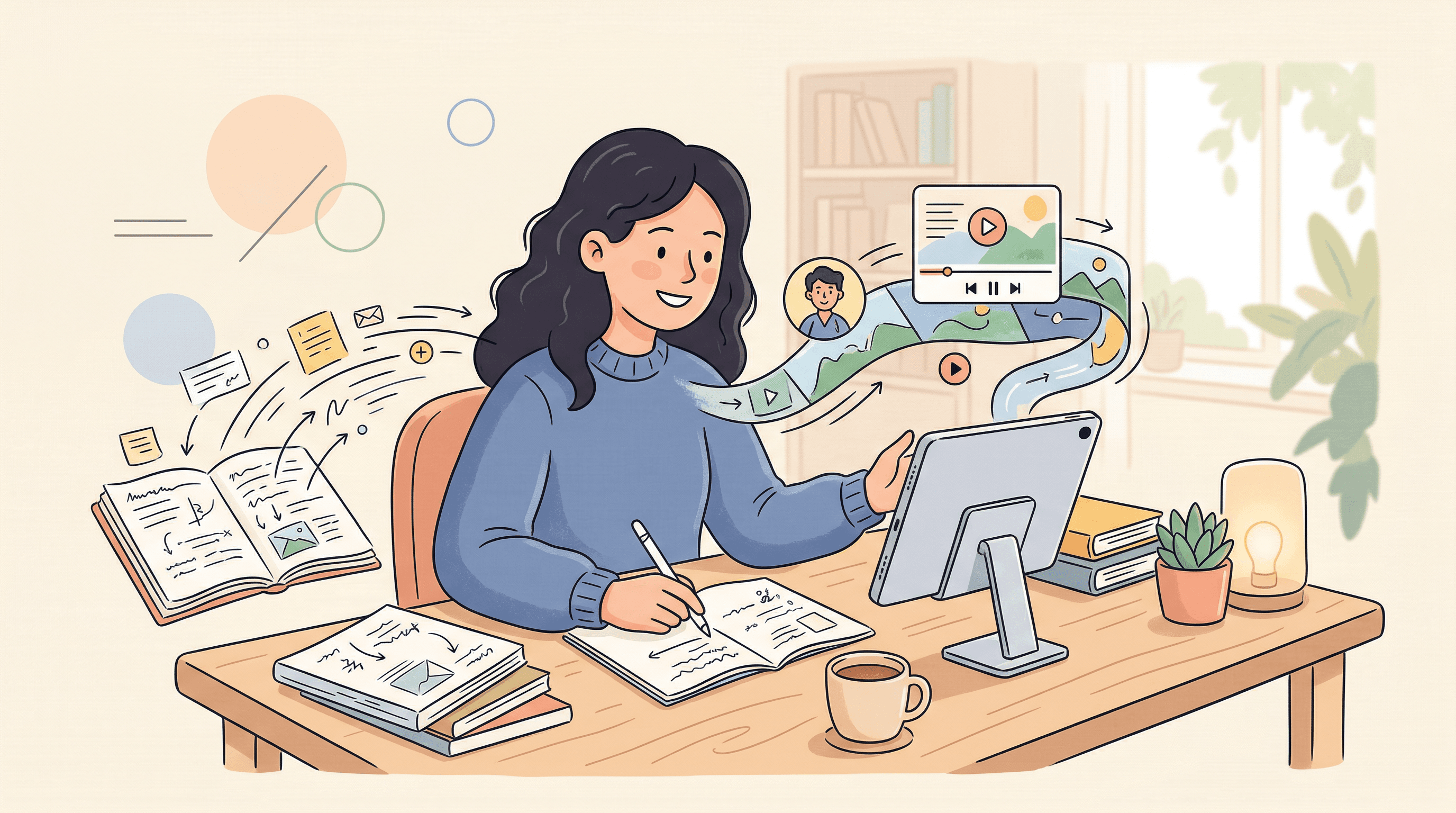
Why Most Study Apps Can't Keep Up With AI-Native Learning

·5 min read

Something shifted in how students study around 2024.
It wasn't the arrival of AI — students had been using ChatGPT since 2022. It was the realisation that using AI within old study systems was producing mixed results. Pasting lecture notes into ChatGPT gave you a summary, but that summary existed outside your study workflow. The AI couldn't see your flashcard performance. It didn't know your exam date. It had no idea which topics you'd already mastered.
Students were adding AI to broken systems. And broken systems with AI still don't work.
The response was a new category of tool: AI-native study platforms — built not to add AI to existing workflows, but to build entirely new workflows around what AI makes possible.
What "AI-Native" Means in Practice
An AI-native study platform is one where AI is not a feature but a foundation. Every part of the system — how you upload content, how your materials are organised, how you review, how you test yourself — is designed with AI at its centre.
The practical difference is significant.
In an AI-assisted tool, you decide what to study. The AI helps you do it faster. In an AI-native tool, the AI helps you decide what to study — then helps you do it more effectively.
This means the AI-native tool knows things the AI-assisted tool doesn't: which concepts you've struggled with across three different subjects, how your retention rate changes over the week, which sections of your uploaded textbook you haven't yet covered in flashcards.
Why Most Study Apps Can't Implement This
Building an AI-native platform is architecturally different from building a traditional app with an AI feature added.
Most study apps store your data in formats designed for human navigation — notebooks, folders, tags. When they add AI, the AI sees the same structure the human interface sees. It can search your notes. It can summarise a document. But it can't reason across your full learning history because that history isn't stored in a format AI can use effectively.
AI-native platforms store your learning data differently — in formats that make it accessible to AI systems across all features simultaneously. Your quiz performance isn't a separate data stream from your flashcard history. They're part of the same model of your current knowledge state. This requires building the platform from the ground up with AI access in mind. It can't be retrofitted.
The Three Biggest Changes AI-Native Learning Produces
1. From Linear to Adaptive Study Plans
Traditional study plans are linear: study chapter 1, then chapter 2, then chapter 3. The plan doesn't change based on what you know.
AI-native study plans are adaptive. If you demonstrate strong understanding of chapters 1 and 3, the system allocates more time to chapter 2 — not because you told it to, but because it tracked your quiz and flashcard performance and identified the gap.
2. From Generic to Personalised Content
The same textbook chapter doesn't mean the same thing to every student. One student struggles with introductory definitions. Another understands concepts but gets application examples wrong.
AI-native tools generate different flashcards, summaries, and questions for different students studying the same material — based on what each student's performance history suggests they need.
3. From Isolated Features to Connected Learning
In traditional study tool collections, your PDF reader doesn't know about your flashcard app. Your flashcard app doesn't know about your practice tests. You connect the dots manually.
AI-native platforms connect these activities automatically. A wrong answer in a quiz resurfaces as a flashcard. A concept flagged in your summary is automatically included in your next review session. The system builds a complete picture of your knowledge state and updates it continuously.
The Practical Impact for Students
Students who switch to AI-native learning from traditional tools consistently report two changes:
First, they spend less time deciding what to study. The system surfaces the right material at the right time. Second, they feel more confident going into exams — not because they've studied more hours, but because they have clearer visibility into what they actually know versus what they've merely covered.
The second change is the more important one. Most exam anxiety comes from uncertainty — not knowing whether you know enough. AI-native tools reduce that uncertainty by replacing "I've read this chapter" with "I've correctly recalled these concepts across five practice sessions."
That's a different relationship with your own knowledge. And it changes how you approach high-stakes assessments.
FAQ
What is AI-native learning?
AI-native learning refers to study systems where artificial intelligence is the foundation of the design, not a feature added to an existing product. Every function — content organisation, review scheduling, quiz generation, Q&A — is built to share AI-readable data, allowing the system to develop an accurate, continuously updated model of your knowledge state.
How is AI-native different from using ChatGPT to study?
ChatGPT is a general-purpose AI with no memory of your study history, no access to your performance data, and no connection between different study activities. AI-native study platforms are purpose-built for learning, with persistent memory across sessions, personalised content generated from your specific materials, and connected features that inform each other.
Which subjects benefit most from AI-native learning?
AI-native learning delivers the greatest benefit for content-heavy subjects with large volumes of material to review: medicine, law, sciences, history, economics. Subjects that are primarily skill-based benefit less from AI summarisation and retrieval practice tools, though quiz generation for conceptual elements remains valuable.
Is AI-native learning suitable for school-age students?
Current AI-native platforms are primarily designed for university and professional-level students managing complex, multi-source academic materials. The benefits scale with the complexity of the material. Simpler AI-assisted tools are generally more appropriate for younger students.
Will AI-native learning become the standard for all study tools?
The trajectory suggests yes, on a 5–10 year horizon. As AI capabilities improve and processing costs decrease, the architecture advantages of AI-native design will make the retrofitted AI approach increasingly uncompetitive. The question is not whether AI-native will become standard, but how quickly existing tools will be rebuilt or replaced.