Best AI Notes Generators for Students in 2026

·8 min read
Taking notes during a lecture — while simultaneously trying to understand what's being said — is a difficult cognitive task. You're splitting attention between listening, comprehending, and writing, and the result is often notes that are either incomplete (you were focusing on understanding) or dense (you were focusing on writing) but rarely both accurate and well-structured.
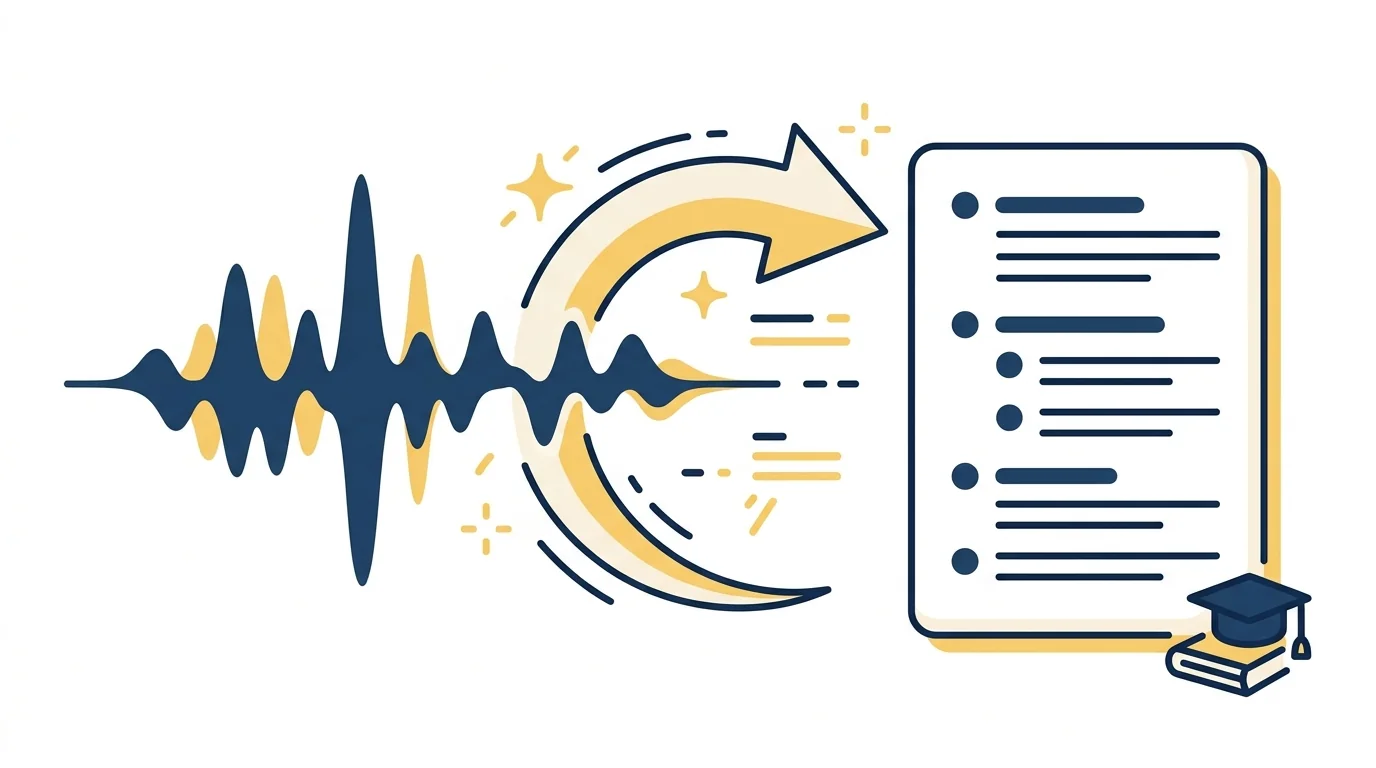
AI notes generators solve a different version of this problem: they take existing source material — a recorded lecture, a PDF, a YouTube video, a set of slides — and produce structured, readable notes from it. You can focus fully on understanding during the lecture, then let AI convert the recording or transcript into notes you can study from.
In 2026, the quality of AI note generation has reached a point where the output is genuinely useful with minimal editing. The variation between tools, however, is significant.
What AI Notes Generators Actually Do
The best AI notes generators work in sequence:
Transcription (for audio/video sources): Converting spoken content to text, handling multiple speakers, accents, and technical vocabulary.
Extraction: Identifying the key concepts, definitions, examples, and structural elements from the transcribed or uploaded text.
Organisation: Structuring the extracted content into a format suited for studying — headings, bullet points, definitions, key term highlighting — rather than a flat transcript.
Enhancement (in the best tools): Adding context, clarifying ambiguous references, identifying likely exam-relevant content, and flagging areas that may need follow-up.
The difference between a basic summariser and a genuinely useful notes generator is in the organisation and enhancement stages. A summariser compresses content. A notes generator restructures it for learning.
The Best AI Notes Generator Tools in 2026
CuFlow
CuFlow processes your uploaded course materials — PDFs, lecture slides, audio recordings, text documents — and generates structured study notes along with flashcards and quiz questions from the same content.
The notes aren't a standalone output: they feed directly into CuFlow's study system. Key terms identified in your notes become flashcard fronts. Conceptual explanations become quiz question material. The connection between note generation and active study is built in, not bolted on.
For students managing multiple subjects, this integration means your notes immediately become revision-ready rather than documents to return to and convert manually. Upload your lecture recording on Monday; your structured notes, flashcards, and first quiz session are ready by Tuesday.
Best for: Students who want AI notes connected to a full study system with spaced repetition and performance tracking.
Otter.ai
Otter.ai is primarily a real-time transcription tool, but its AI note features — summary generation, action item extraction, and chapter segmentation — make it useful for students who want structured output from live or recorded lectures.
The note quality depends on transcription accuracy, which is generally strong for standard academic English. Technical vocabulary, multiple speakers, and non-native accents reduce accuracy. The free tier limits monthly transcription minutes, which is a constraint for students with heavy lecture loads.
Best for: Students who want live lecture transcription plus automated summary generation in one tool.
Notion AI
Notion's AI can generate structured notes from pasted text, summaries of long documents, and organised outlines from unstructured content. If you're already using Notion as your primary notes system, asking its AI to reorganise and enhance your rough notes is a low-friction workflow.
The limitation for lecture-to-notes workflows: Notion AI doesn't process audio or video natively. You need to get the text into Notion first, which adds a step.
Best for: Students embedded in the Notion ecosystem who want AI enhancement of existing text notes.
Notta
Notta transcribes audio and video recordings and generates structured summaries and key points from the content. It supports over 50 languages, making it useful for international students or those studying in multiple languages.
The notes output is structured — not just a raw transcript — with identified speakers, timestamped segments, and extracted key points. Integration with study systems is limited; Notta is primarily a capture and summary tool.
Best for: Students who need multilingual transcription and structured summaries from recorded lectures.
tl;dv
Originally designed for meeting transcription, tl;dv has become popular among students for processing recorded lectures and seminars. It allows you to mark key moments during recording, generates AI summaries by topic, and supports exporting notes in structured formats.
The timestamped navigation is particularly useful for lectures where you want to return to specific explanations without listening to the whole recording again.
Best for: Students who record seminars and want timestamped, searchable notes with topic-based navigation.
Whisper + Custom Processing
For students comfortable with some technical setup, OpenAI's Whisper model transcribes audio with among the highest accuracy available, and piping the transcript through an AI assistant (Claude, ChatGPT) with a detailed structuring prompt produces excellent notes at low cost.
The workflow is manual but flexible: you control the prompt, the level of detail, and the output format. This approach is particularly effective for technical content where standard tools produce less accurate transcription.
Best for: Technical students who want maximum accuracy and are comfortable with a multi-step workflow.
Evaluating AI Notes Quality
Not all AI-generated notes are usable without editing. Common quality issues to watch for:
Structural flatness: The AI produces a continuous summary rather than hierarchically structured notes. Look for tools that generate headings, subheadings, and organised bullet points rather than paragraphs.
Surface compression: The AI removes detail indiscriminately, cutting examples and mechanisms that are actually exam-relevant. Good note generators identify what's important to retain, not just what's shortest to represent.
Generic content: Notes that don't reflect the specific framing, emphasis, or terminology of your professor or course. This is most visible when you compare AI-generated notes to what actually appeared on your exam.
Transcription errors propagated into notes: Errors in the transcript become errors in the notes. Always cross-reference AI notes against your own understanding of what was covered.
A quick quality check: after reviewing AI-generated notes, close them and test yourself on a few key concepts. If you can recall them accurately, the notes are doing their job. If they feel vague or disconnected from your understanding, they need editing.
How to Get the Best Output from AI Notes Generators
Upload high-quality source material: Clear audio, well-formatted PDFs, and complete lecture slides produce better notes than poor-quality recordings or scanned handwritten pages.
Specify your context: Many tools improve with context. Telling the AI "this is a second-year university biochemistry lecture on enzyme kinetics" produces more appropriate vocabulary handling and structural choices than a generic upload.
Edit before you study: Spend ten to fifteen minutes reviewing AI-generated notes before using them for revision. Correct errors, expand thin sections, and add any context you remember from the lecture that the AI missed.
Connect notes to active recall: Notes are input, not output. After reviewing AI-generated notes, test yourself on the content before the next session. The notes tell you what to learn; retrieval practice is how you learn it.
CuFlow's Notes-to-Study Pipeline
CuFlow is built around the insight that note generation and studying should be connected, not sequential. Most tools produce notes you then have to decide what to do with. CuFlow generates notes and immediately routes the content into a study system:
- Key concepts become flashcard fronts
- Definitions become practice question material
- Identified exam-relevant content gets prioritised in your study schedule
- Your performance on related quiz questions feeds back into how often the note content resurfaces
For students who consistently generate notes but struggle to convert them into effective study sessions, this pipeline removes the gap between capture and learning.
FAQ
What is the best AI notes generator for students?
For notes connected to a study system, CuFlow is the strongest option. For live lecture transcription with structured summaries, Otter.ai is widely used and reliable. For multilingual support, Notta handles the widest range of languages. For maximum transcription accuracy on technical content, Whisper-based workflows perform best.
Can AI generate notes from a recorded lecture?
Yes. Tools like CuFlow, Otter.ai, Notta, and tl;dv all accept audio recordings and generate structured notes. Accuracy varies with recording quality, number of speakers, and technical vocabulary density. For clear recordings with a single speaker, output quality is generally high with minimal editing required.
How accurate are AI-generated notes?
For well-recorded lectures in standard academic English, accuracy is typically high — most key concepts and definitions are captured correctly. Errors increase with poor audio quality, heavy accents, highly technical vocabulary, or rapid speech. Always review AI notes against your own understanding before studying from them.
Can AI take notes from a YouTube lecture?
Yes. Tools like CuFlow can process YouTube URLs or downloaded video files. Some tools also accept direct URL input and extract audio for transcription. This is particularly useful for students supplementing their course with recorded lectures from other universities or instructors.
Do AI notes generators work for handwritten notes?
Some do. Tools with OCR (optical character recognition) capability can process photos of handwritten notes. Quality depends heavily on handwriting legibility. For dense or cursive handwriting, accuracy may be insufficient to produce reliable notes without significant editing.
Should I still take my own notes if I use an AI notes generator?
Brief in-session notes focused on your understanding — questions that arise, connections you notice, points the professor emphasises — are valuable even when using an AI generator. Your own notes capture your cognitive engagement; AI notes capture the content. The combination is typically more effective than either alone.