
The Leitner Method: How the Original Spaced Repetition System Works

·8 min read
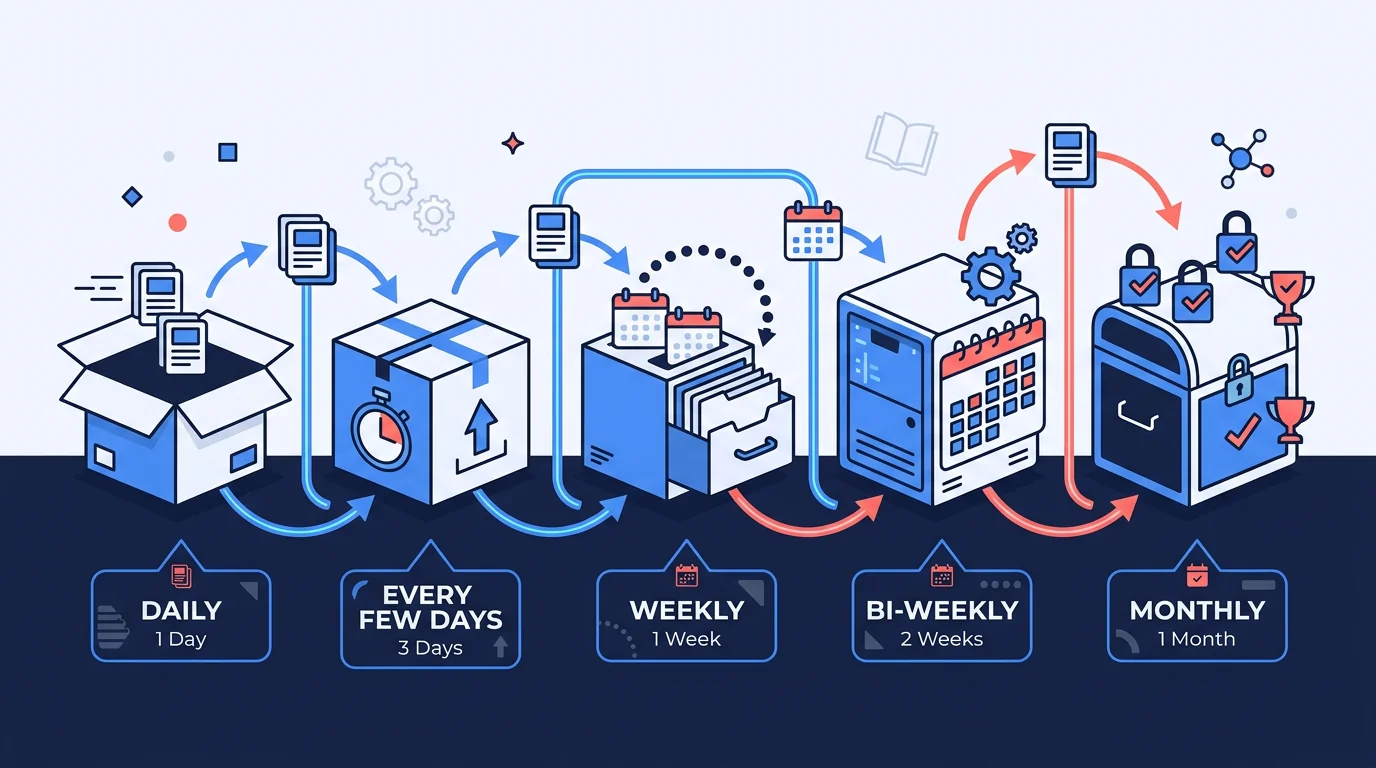
Before apps, algorithms, and AI-generated flashcards, there was a cardboard box. Sebastian Leitner, a German science journalist, published a remarkably effective study method in his 1972 book So lernt man lernen — roughly translated as How to Learn to Learn. The system he described is now known as the Leitner Method, and it's the direct ancestor of every spaced repetition app used today.
If you've heard the term but aren't sure exactly how it works, this post covers everything: the origin, the mechanics, the underlying science, a concrete example, and how modern tools like Anki and CuFlow build on the same foundation.
Who Was Sebastian Leitner?
Leitner wasn't a learning scientist by training. He was a journalist who became obsessed with the question of how humans remember information efficiently. After studying existing research on memory — including early work on what we'd now call the forgetting curve — he designed a practical system that anyone could use at home with index cards and a divided box.
His insight was simple but powerful: you don't need to review every card every day. You only need to review a card when you're about to forget it. Review too early and you waste time. Review too late and the memory has already decayed. The Leitner System is a manual mechanism for finding that timing.
The Physical System: Five Boxes Explained
The original Leitner System uses a cardboard box divided into five compartments, numbered 1 through 5. Each compartment has a review schedule:
- Box 1 — review every day
- Box 2 — review every two days
- Box 3 — review every four days
- Box 4 — review every week
- Box 5 — review every two weeks (or considered "learned")
Every card starts in Box 1. When you review a session, you pull the cards from the boxes that are due according to the schedule.
Here's the key rule:
- Answer correctly → card moves to the next box (Box 1 → Box 2, Box 2 → Box 3, and so on)
- Answer incorrectly → card goes back to Box 1, regardless of where it was
That last point is what makes the system work. Cards you struggle with stay on a short review cycle. Cards you know well gradually move to longer intervals. Over time, your energy is automatically focused on the material you haven't mastered yet.
A Concrete Example
Let's say you're studying Spanish vocabulary. You write the Spanish word on one side of a card and the English translation on the other.
Day 1: You review all the new cards in Box 1. You get libro (book) right, so it moves to Box 2. You get ventana (window) wrong, so it stays in Box 1.
Day 2: You review Box 1 again. ventana comes up again. This time you get it right — it moves to Box 2. You also review Box 2, and libro comes up. You get it right again, so it moves to Box 3.
Day 4: Box 1 is due again. Box 3 is also due for its first review. libro appears. You blank on it — it drops back to Box 1.
This is the system working exactly as intended. libro felt familiar but wasn't fully consolidated. The demotion back to Box 1 puts it on a short cycle so you'll encounter it frequently until it sticks.
Over weeks, cards that you reliably know will work their way toward Box 5, freeing up your review time for cards that still need work.
Why Spacing Works: The Forgetting Curve
The logic behind the Leitner System comes from the forgetting curve, first described by German psychologist Hermann Ebbinghaus in the 1880s. Ebbinghaus found that memory decays in a predictable pattern — quickly at first, then more slowly. Crucially, each successful retrieval flattens the curve, meaning the same information takes longer to forget after each recall.
The Leitner System exploits this by timing reviews to happen just before the memory would naturally fade. The result is that you spend the minimum amount of time necessary to keep information accessible over the long term.
This isn't just theory. Decades of research in cognitive science have confirmed that spaced retrieval practice is one of the most effective study techniques available — consistently outperforming re-reading, summarising, and highlighting.
Physical vs Digital: The Trade-offs
The physical Leitner System has real advantages. It's tactile, cheap, and free from the distraction of a screen. Writing cards by hand also aids encoding — the act of formulating a question and answer forces you to think about the material.
But it has limitations that matter at scale:
- Volume: Managing hundreds or thousands of cards across five boxes is cumbersome
- Scheduling accuracy: Manually tracking which boxes are due on which day is error-prone
- Portability: A physical box doesn't travel as well as an app
- Analytics: You can't see patterns in your errors or track progress over time
These limitations are exactly why digital implementations became popular.
How Anki Implements Leitner-Inspired Scheduling
Anki doesn't use the Leitner System directly. It uses the SM-2 algorithm, developed by Piotr Wozniak in the late 1980s as a computed improvement on Leitner's principles. SM-2 keeps the core idea — space intervals based on recall performance — but makes the interval calculation more precise.
Instead of fixed box schedules (every day, every two days, etc.), SM-2 calculates a personalised interval for each card based on how many times you've recalled it and how confident your response was. A card you get right with high confidence gets a longer interval than one you recalled with hesitation.
The difference matters. With a physical Leitner box, two cards in Box 3 get the same review interval even if one has been reviewed there three times and the other just arrived. SM-2 treats them differently. This makes the review schedule more accurate over time, especially for large decks.
How CuFlow Builds on This Foundation
Modern AI study platforms take these principles further. CuFlow's spaced repetition system tracks your recall performance on every card and uses that data to schedule reviews at the optimal moment — the same underlying principle as Leitner, but with substantially more precision than a physical box allows.
What CuFlow adds beyond scheduling is generation. Rather than requiring you to write every card manually, you can upload your notes, slides, or readings and have the system create flashcards from your own material. The spaced repetition logic then applies automatically — you don't need to manage boxes or track schedules yourself. The platform handles the timing while you focus on actually learning.
This is worth thinking about if you're studying from a large volume of course material. The Leitner System's core insight — review at the right moment, not at fixed intervals — scales much better when it's handled algorithmically.
Pros and Cons vs Modern SM-2
| Leitner System | SM-2 / Modern Apps | |
|---|---|---|
| Setup cost | Low (cardboard box, index cards) | Low (download an app) |
| Scheduling precision | Fixed box intervals | Personalised per-card |
| Volume capacity | Limited by physical space | Thousands of cards |
| Analytics | None | Full performance history |
| Distraction risk | None | App environment |
| Tactile benefit | High | None |
Neither approach is universally better. The physical Leitner System works well for a focused set of cards — vocabulary for a single exam, key terms for a course, definitions for a certification. For larger, longer-term study programs, a digital implementation with SM-2 or similar scheduling is usually more practical.
How to Set Up a Physical Leitner System Today
If you want to try the original method:
- Get a long index card box and five dividers labelled 1–5
- Write your study cards — one question per card, answer on the back
- Start all cards in Box 1
- Review Box 1 every day; set calendar reminders for Boxes 2–5 according to the schedule
- Move cards forward on correct answers, back to Box 1 on wrong answers
- Once cards reach Box 5, review them monthly or consider them consolidated
Keep the decks small at first. Fifty cards is a manageable starting set. You'll get a feel for the rhythm within a week.
FAQ
What is the Leitner System?
The Leitner System is a spaced repetition study method created by Sebastian Leitner in 1972. It uses a five-box card system where flashcards move to longer review intervals when answered correctly, and return to Box 1 when answered incorrectly. It's designed to concentrate review time on the cards you haven't mastered.
How is the Leitner System different from Anki?
Anki uses the SM-2 algorithm, which is based on the same principles as the Leitner System but calculates personalised intervals for each card rather than fixed box schedules. SM-2 is more precise for large card sets. The Leitner System is simpler and can be done with physical cards.
How many boxes does the Leitner System use?
The original system uses five boxes with review intervals of 1, 2, 4, 7, and 14 days. Some adaptations use more boxes with longer final intervals. The number of boxes isn't fixed — the principle is what matters: correct answers increase the interval, incorrect answers reset it.
Is the Leitner System effective?
Yes. It's based on the well-established principles of spaced repetition and retrieval practice, both of which have strong support in cognitive science research. It's particularly effective for factual material — vocabulary, definitions, formulas, dates, and similar discrete information.
Can I use the Leitner System digitally?
Yes. Anki allows you to use a "Leitner-style" mode, and many flashcard apps implement some version of spaced repetition. AI study platforms like CuFlow go further by generating cards from your notes and automating the scheduling entirely, which makes the system practical at much larger scale.