Online Learning Apps: What Makes a Good One and the Best Options in 2026

·10 min read
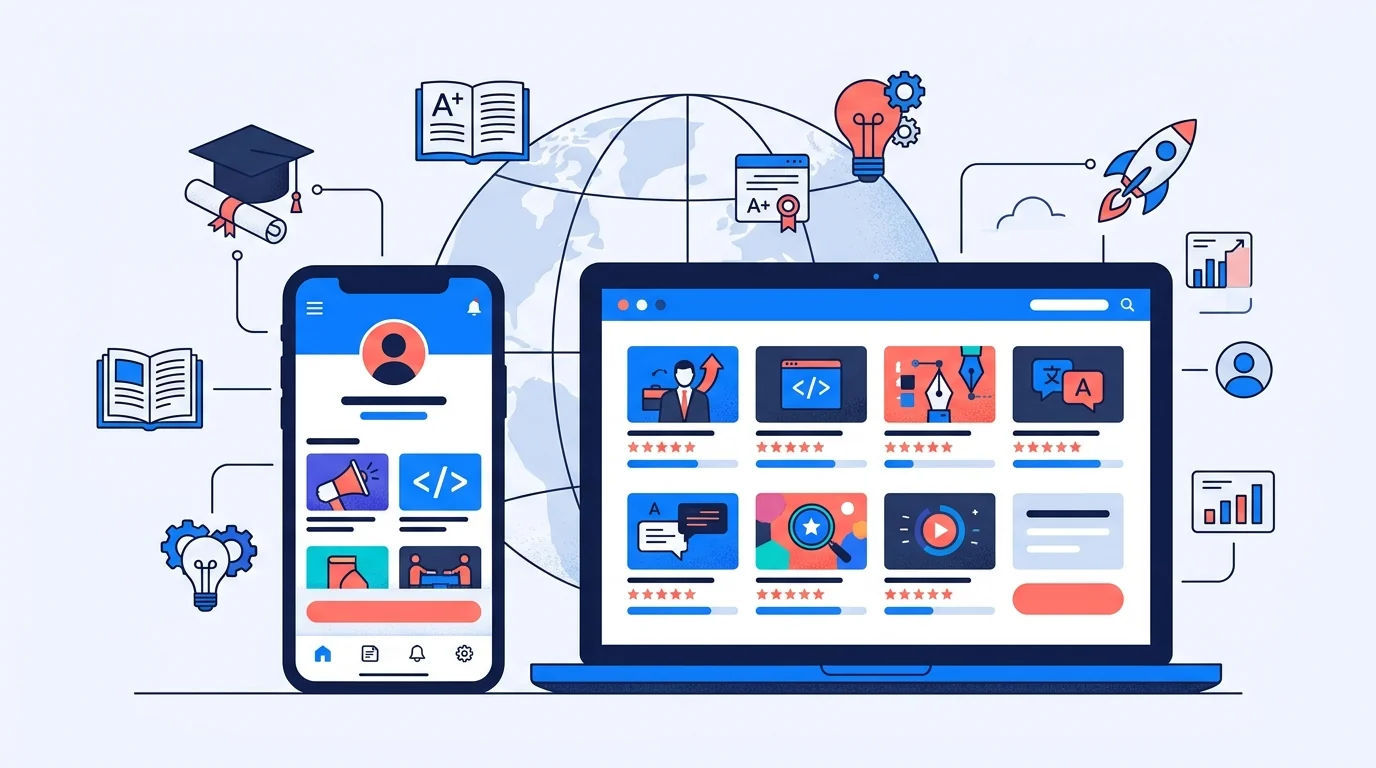
The category of online learning apps is large enough that the term has almost stopped meaning anything. It covers everything from structured university-level courses to vocabulary games, AI-generated flashcard sets, and YouTube channels with a companion app. They're not the same thing, and choosing the right one requires knowing what problem you're actually trying to solve.
This post breaks down the major categories, explains what separates genuinely useful apps from ones that just look impressive, and gives an honest overview of the platforms worth your time in 2026 — including how to pick based on your actual goal.
The Main Categories of Online Learning Apps
Before comparing specific apps, it helps to understand that "online learning app" covers at least five distinct categories, each designed for a different purpose.
Structured course platforms
These platforms offer video-based courses, often with assessments, certificates, and defined curricula. Coursera, edX, and Udemy are the most prominent examples. The model is lecture → reading → quiz → certificate. It closely mirrors a traditional course structure, which is both a strength and a limitation.
AI study assistants
A newer category, AI study tools help you process and retain your own study material rather than delivering external content. They generate flashcards, quizzes, and summaries from your notes, slides, or readings, then use spaced repetition to ensure you review material at the right intervals. CuFlow sits in this category.
Language learning apps
A specialised subset with its own distinct mechanics — spaced vocabulary, speaking practice, listening comprehension, and gamified progression. Duolingo, Babbel, and Pimsleur are the main players.
Concept and skill-specific platforms
Platforms that teach a specific domain very deeply — mathematics, programming, physics, chess — often with interactive problem-solving rather than video lectures. Brilliant and Khan Academy fall into this category.
Productivity and note-taking tools
Apps like Notion or Obsidian aren't learning platforms by design, but many students use them as the backbone of a personal learning system. They sit at the edge of this category.
What Separates Genuinely Useful Apps From Feature-Heavy Ones
The number of features in an app doesn't predict how useful it'll be for learning. Here's what actually matters.
A real retention mechanism
The most important question to ask about any learning app: what does it do to help you actually remember what you've studied?
Reading content through an app is not meaningfully different from reading a textbook. It's the mechanism for retrieval and review that determines whether learning sticks. Spaced repetition, active recall quizzes, and interleaved practice are evidence-based. Progress bars, learning streaks, and course completion percentages are not — they measure activity, not retention.
Apps that have a genuine retention mechanism built into their core design are worth more than apps that are essentially content delivery with a polished interface.
Content quality
For structured course platforms specifically, the quality of instruction matters enormously. A well-designed course from a domain expert with clear explanations and well-sequenced content is worth far more than 40 hours of mediocre video.
This is harder to assess before you commit to a course, but user reviews that specifically address explanation quality (not just production value) and completion rates relative to course length are useful signals.
UX friction
Friction is often underestimated as a factor. An app you'll use consistently because it's fast to open and easy to navigate is more valuable than a theoretically superior app that you avoid because it's slow or confusing to use.
This is particularly relevant for mobile use. If you're planning to study in short sessions on your phone — between classes, on public transport — you need an app that gets you into a study session in under 30 seconds, not one that requires navigation through multiple menus.
Match to your actual goal
An app is only useful if it matches what you're trying to accomplish. A structured course platform is a poor tool for revising lecture notes before an exam. An AI flashcard tool is a poor tool for learning a new subject from scratch. The best app for you is the one that fits your specific goal.
The Best Online Learning Apps by Category in 2026
Structured courses: Coursera and edX
Coursera and edX remain the strongest options for structured, accredited course content. Both partner with universities and established institutions to deliver courses that carry meaningful credentials in professional and academic contexts.
Coursera has the larger library and a more polished interface. edX has strong university partnerships, particularly in STEM fields. Both offer audit access to most courses for free, with certificates requiring payment.
The limitation they share: completion rates are low across the industry, partly because structured courses require consistent, self-directed engagement over weeks or months — something that's hard to maintain without external accountability.
Language learning: Duolingo
Duolingo is the most widely used language learning app in the world, and for good reason. The gamification mechanics — streaks, experience points, leagues — create genuine motivation for daily engagement, which is exactly what language learning requires. Vocabulary and grammar are introduced progressively with spaced repetition underneath the game layer.
Its weaknesses are also real. Duolingo's content becomes less useful at intermediate and advanced levels, it doesn't teach production fluency effectively, and it heavily favours recognition over recall. For absolute beginners building a habit, it's excellent. For serious language study beyond the basics, it needs supplementing.
Fundamentals: Khan Academy
Khan Academy covers K–12 content and introductory university-level mathematics, science, economics, and humanities. The explanations are reliable and genuinely accessible. For students who have gaps in foundational knowledge — especially in mathematics — it's one of the most underrated free resources available.
It's not designed for exam preparation or advanced study, and it doesn't adapt meaningfully to your existing knowledge. But for building or repairing a foundation, it's hard to match at any price.
Concept learning: Brilliant
Brilliant focuses on active learning through problem-solving rather than passive video watching. Courses in mathematics, data science, logic, physics, and computer science are structured around interactive problems that require genuine engagement rather than recognition.
The quality of instruction and problem design is high. It's subscription-based and the library isn't as broad as a general platform, but within its focus areas it teaches conceptual understanding more effectively than lecture-based alternatives.
AI-assisted study from your own material: CuFlow
CuFlow is designed for students who have their own material to study — lecture notes, slides, textbooks, PDFs — and need to retain it for exams or assessments. You upload your content, and CuFlow generates flashcards, quizzes, and summaries from it. A spaced repetition system then schedules review sessions based on what you actually recall.
This is a different use case from structured course platforms. CuFlow doesn't teach you a subject from scratch — it helps you master material you're already working with. For university students, school students, and professional certification candidates, that's often the more pressing need.
What makes it distinct from a standard flashcard app is the AI generation layer. You're not spending time writing cards manually; you're spending time actually studying. And the platform tracks retention, not just time spent, which gives you genuinely useful data about where your understanding is weak.
How to Choose Based on Your Goal
Use this table to match your situation to the right type of app.
| Your goal | Best category | Example apps |
|---|---|---|
| Learn a new subject from scratch | Structured course platform | Coursera, edX |
| Pass an exam on content you've studied | AI study assistant | CuFlow |
| Learn or improve a language | Language learning app | Duolingo + supplementary practice |
| Fix gaps in mathematics or science fundamentals | Concept platform | Khan Academy, Brilliant |
| Develop a professional skill (coding, design, data) | Structured course or skill platform | Coursera, edX, Brilliant |
| Study from your own lecture notes | AI study assistant | CuFlow |
| Explore a topic casually | Any well-reviewed course | Coursera audit, YouTube + Khan Academy |
The single most useful question to ask: am I trying to learn new content, or am I trying to retain and master content I already have?
If you're learning from scratch, a structured course or concept platform is the right starting point. If you're working with existing material — course notes, assigned readings, a textbook you're studying — an AI study tool is more appropriate. These aren't the same problem, and conflating them is the most common reason students end up with an app that doesn't serve them.
Common Mistakes When Choosing a Learning App
Choosing by design. A beautifully designed app with a well-produced demo can obscure the absence of a real learning mechanism. Look for evidence of retention support — not just content delivery.
Using too many apps at once. Three learning apps covering the same subject creates switching overhead and makes it easy to convince yourself you're studying when you're mostly managing tools.
Optimising for streaks instead of understanding. Streaks and completion percentages are engagement mechanics. They're not reliable indicators of how much you've learned. If you're studying to maintain a streak rather than to understand something, you're optimising for the wrong thing.
Picking a course platform when you need a study tool. Taking a Coursera course on the same subject you're already studying at university might be interesting, but it won't directly help you retain your lecture material for the exam. The right tool is the one that addresses your actual gap.
FAQ
What's the best online learning app overall?
There isn't a single best app because different apps solve different problems. For structured courses, Coursera and edX lead. For language learning, Duolingo is the most effective entry point. For concept learning, Brilliant stands out. For studying your own material with AI support, CuFlow is designed specifically for that.
Are online learning apps effective?
They can be, with the right conditions. Apps with genuine retention mechanisms — spaced repetition, active recall, interleaved practice — produce better long-term retention than passive content delivery. Effectiveness also depends heavily on consistency and match between the app's design and your specific goal.
What's the difference between an online course platform and an AI study app?
Course platforms deliver content that you don't already have — video lectures, readings, and structured curricula. AI study apps help you process and retain content you already have, such as your own notes or course materials. Both are useful, but they solve different problems. Many students benefit from using a course platform alongside an AI study tool.
Can I learn effectively from an app without a teacher?
Yes, for many subjects. App-based learning works best for well-defined domains — vocabulary, mathematics, programming concepts, factual content — where quality content and a solid retention mechanism are the key variables. For subjects that require nuanced feedback on your thinking or writing, human instruction is harder to replace.
How many learning apps should I use at once?
One or two. More than that and the overhead of switching between tools starts to outweigh the benefits of each individual app. A useful combination is one tool for your study session content (like CuFlow for your notes) and one for a skill you're developing on the side (like Duolingo for a language).