
The SQ3R Method: How to Use It and Whether It Actually Works

·10 min read
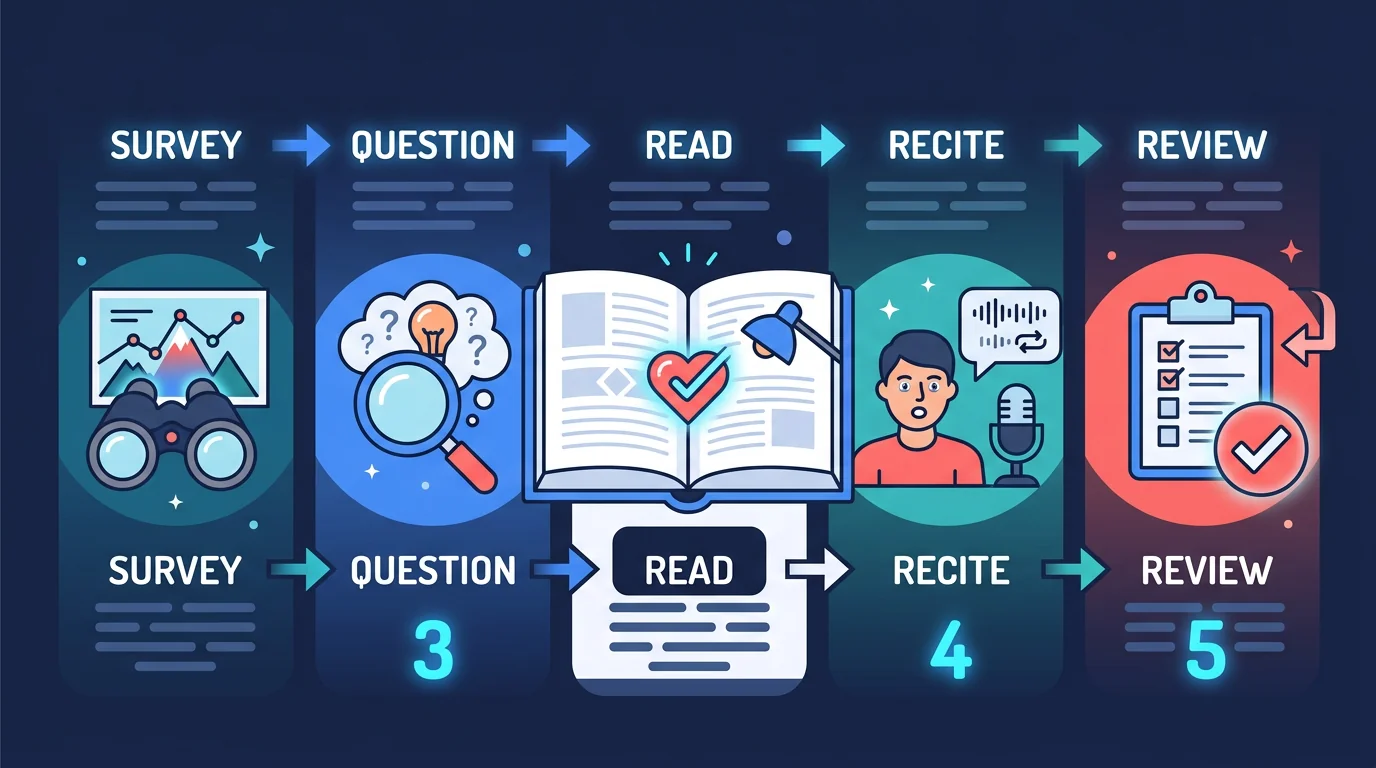
SQ3R has been taught in study skills courses for more than 80 years. It appears in educational psychology textbooks, university learning center guides, and countless listicles about how to study better. Given how long it's been around, it's worth asking a direct question: does it actually work, and is it worth the time it takes?
The honest answer is: it depends heavily on what you're reading and what your goal is. SQ3R is genuinely useful in specific contexts and overused in others. This guide will explain the method fully, look at what the research says, and help you decide when it's worth applying.
Where SQ3R Came From
Francis Robinson developed SQ3R at Ohio State University in 1941 and published it in his book Effective Study. Robinson designed it specifically for college students struggling to get useful information out of dense textbooks. The underlying insight was that passive reading — running your eyes over words in sequence — is an inefficient way to learn from complex material.
SQ3R was designed to make reading an active process, to give the reader a purpose before they start, and to build in retrieval practice after reading. These ideas have held up well. The specific implementation has its limitations, but the principles behind it are sound.
The Five Steps Explained
Survey
Before you read anything in detail, spend 5–10 minutes scanning the entire chapter or section. Look at headings and subheadings, read the introduction and conclusion, examine any diagrams, tables, or highlighted terms, and skim any chapter summaries.
The purpose is to build a mental scaffold before you fill it in. You're establishing the structure of what you're about to read so that each section has somewhere to fit when you encounter it. Psychologically, this activates relevant prior knowledge and sets up what cognitive scientists call an "advance organizer" — a framework that improves encoding of subsequent material.
Don't skip this step because it feels like skimming. It takes 5 minutes and meaningfully changes how well you comprehend what comes next.
Question
For each heading and subheading, convert it into a question before you read that section. A heading like "The Role of Dopamine in Motivation" becomes "What role does dopamine play in motivation?" A heading like "Causes of the French Revolution" becomes "What caused the French Revolution?"
Write these questions down. The act of writing them is part of the process — it forces you to engage actively with the structure before you've read the content.
This step creates a specific purpose for reading each section. You're not reading to absorb everything; you're reading to answer a question. This focus tends to improve comprehension and makes it much clearer what to pay attention to.
Some students generate questions from bold terms, learning objectives listed at the beginning of the chapter, or from practice questions if the textbook includes them. All of these work.
Read
Now read the section actively, with the goal of answering the question you generated. Don't highlight everything. Don't take detailed notes yet. Read to understand, with the specific question in mind.
This is different from how most people read textbooks. Most people try to absorb everything, which often means absorbing nothing particularly well. Reading to answer a specific question forces prioritization — what's relevant to this question, and what's background?
If you encounter something confusing, note it (physically mark the page or jot a brief note) rather than re-reading it multiple times. Move through the section, then come back. Getting stuck on one difficult paragraph and re-reading it repeatedly is a low-return use of time.
Recite
After reading each section — not after the whole chapter — close the book or look away and try to answer your question from memory. Don't look back at the text. This is deliberate retrieval practice.
If you can answer the question, good — continue to the next section. If you can't, re-read the relevant part of the section, not the whole thing, and try again.
This is the most valuable step in SQ3R and the one most students skip because it feels uncomfortable. The discomfort is the point. The effortful process of trying to retrieve information from memory strengthens the memory trace more than re-reading does. This is well-established in cognitive psychology as the "testing effect" or "retrieval practice effect."
Robinson recommended reciting answers aloud or writing them down in brief notes. Both are more effective than a mental summary, because they force more complete retrieval.
Review
After completing the entire chapter using the Survey–Question–Read–Recite cycle, spend 10–15 minutes reviewing. Look at all the questions you generated and try to answer each one from memory. Check your answers. Note anything you couldn't recall.
This is a comprehensive retrieval attempt across the whole chapter. It surfaces gaps you didn't notice during the section-by-section recitation and reinforces connections between sections.
The review step also serves as a natural transition to spaced repetition: the questions you couldn't answer in the final review are the ones you need to return to later.
What the Research Actually Says
A 2013 review by Dunlosky and colleagues, published in Psychological Science in the Public Interest, is probably the most comprehensive analysis of study techniques available. The researchers evaluated ten common techniques on criteria including learning conditions, student characteristics, and evidence quality.
SQ3R wasn't evaluated as a single technique, but its component strategies were. The findings are instructive:
Practice testing (the Recite and Review steps) received a "high utility" rating — the highest in the review. The evidence for retrieval practice improving long-term retention is strong and consistent.
Elaborative interrogation and self-explanation — which the Question step partially promotes — received "moderate utility" ratings.
Re-reading, which SQ3R is specifically designed to replace, received "low utility."
The implication: SQ3R's value comes primarily from the retrieval practice built into the Recite and Review steps. The Survey and Question steps are useful for comprehension, but the mechanism that actually makes SQ3R more effective than passive reading is forcing you to retrieve information from memory.
When SQ3R Works Well
SQ3R is most useful for:
Dense expository textbooks — the kind with clearly structured headings, defined terminology, and chapters organized around specific learning goals. SQ3R was designed for exactly this format.
Technical and professional material where you need to retain specific information, not just the general gist. Legal texts, medical reference material, academic papers (with modification), and technical manuals all fit.
Preparation for examinations where you'll be tested on specific facts, concepts, and their relationships. The retrieval practice built into SQ3R is directly applicable to test performance.
When SQ3R Doesn't Work Well
Narrative or literary reading — converting chapter headings of a novel into questions and then reciting answers misses the point of the text entirely.
Light or overview reading where you're skimming for general familiarity, not retention. The overhead of running the full SQ3R process on a blog post or news article is not justified.
When you're time-constrained — SQ3R takes significantly longer than passive reading. A chapter that takes 30 minutes to passively read might take 50–70 minutes with SQ3R. If your goal is coverage rather than retention, that's often not the right trade-off.
Poorly structured texts — books without meaningful headings, texts organized by narrative rather than by concept, and dense academic papers with long unbroken paragraphs don't lend themselves to the Survey and Question steps.
How SQ3R Compares to Similar Methods
PQ4R
PQ4R (Preview, Question, Read, Reflect, Recite, Review) extends SQ3R with an explicit "Reflect" step, where you pause to connect new material to prior knowledge and think about implications. The research support is similar to SQ3R, and the Reflect step is a meaningful addition for material that requires deep understanding rather than factual recall.
KWL
KWL (Know, Want to Know, Learned) is a simpler method most common in K-12 settings. Before reading, you list what you already know and what you want to find out; after reading, you list what you learned. It's less structured than SQ3R, doesn't build in retrieval practice, and is better suited to introductory material than to dense technical content.
Cornell Notes
Cornell Notes are a note-taking system rather than a reading method, but they complement SQ3R well. The cue column (narrow left column) is used to write the questions generated in the Question step; the note section captures material from reading; the summary at the bottom serves the Review function. Combining the two gives you both a reading method and a structured review document.
Pairing SQ3R with Digital Tools
The Question step generates a list of study questions naturally. These are directly usable as flashcard fronts — the question on one side, your recited answer on the other. Tools like CuFlow can automate part of this process: if you upload your textbook chapter or paste in the section you're studying, it generates quiz questions and flashcards from the material. This doesn't replace the thinking involved in converting headings to questions yourself, but it's useful for adding breadth — catching concepts you might not have thought to make into questions.
The Review step also maps well onto spaced repetition: returning to your SQ3R questions on a schedule (the next day, three days later, a week later) improves long-term retention significantly compared to a single review session.
The Time Cost Is Real
It's worth being direct about this. SQ3R is slower than passive reading. Students often find it frustrating at first because it feels inefficient. The payoff is retention — you understand more of what you read and you remember more of it later. If your goal is to cover a large amount of material quickly, SQ3R is the wrong tool. If your goal is to actually learn and retain what you read, especially from dense technical material, the time investment tends to pay off.
The method has been taught for over 80 years because the core principles — active engagement before reading, specific purposes for reading, retrieval practice after reading — are consistently supported by learning science. The framing has changed and the branding has evolved, but the underlying logic holds.
Frequently Asked Questions
How long does SQ3R take compared to regular reading?
Roughly 1.5–2x longer, depending on the material and how thoroughly you apply the Recite and Review steps. A 30-minute passive reading session might take 45–60 minutes with SQ3R. For material you actually need to retain, this is usually worth it. For material you're just surveying, it probably isn't.
Can I use SQ3R with academic papers?
With modification. Academic papers don't always have subheadings, so the Survey step involves reading the abstract, introduction, and conclusion before the methods and results. The Question step can draw on the research questions stated in the introduction. The Recite and Review steps apply as normal. The method is usable but requires more adaptation than with structured textbooks.
Is SQ3R suitable for all subjects?
It's most suitable for subjects taught through expository textbooks — sciences, social sciences, history, law, medicine, engineering. It's less appropriate for mathematics (which requires practice problems more than reading comprehension) and literary subjects (where meaning comes from the text itself, not from factual recall).
Do I need to write everything down?
The Question step benefits from writing because it forces specificity. The Recite step benefits from speaking aloud or brief written notes because it forces more complete retrieval than a mental summary. The Review step benefits from written notes because you can check your recall against what you wrote during reading. Purely mental execution is possible but less effective.
What's the most important step in SQ3R?
Recite. The retrieval practice built into the Recite step — closing the book and trying to answer your question from memory — is where most of the learning happens. Students who Survey and Question but then passively re-read instead of actively reciting are getting a fraction of the benefit.