
Ace Grader Alternatives: Better AI Essay Grading Tools for Students in 2026

·10 min read
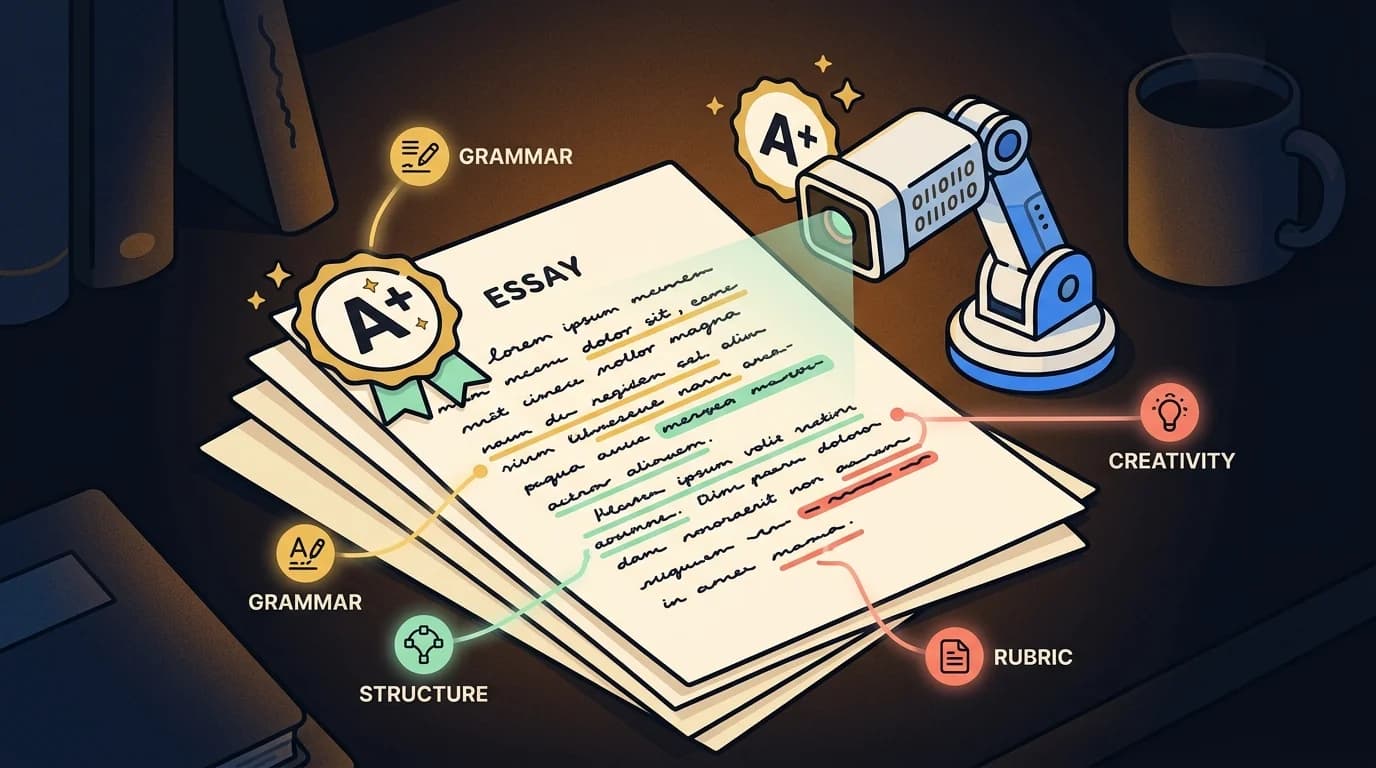
Ace Grader has earned a place in many students' toolkits as a straightforward AI essay grading tool. It offers quick feedback, rubric-based scoring, and a clean interface that makes getting an essay reviewed feel effortless. But it isn't the only option — and depending on your specific needs, it may not be the best one.
Whether you're looking for more detailed writing analysis, tighter rubric alignment, better support for academic writing conventions, or simply a tool that integrates more smoothly into your study workflow, there are strong alternatives available in 2026. This guide breaks down what Ace Grader does, where it has limitations, and which tools are worth considering instead.
What Is Ace Grader and What Does It Do?
Ace Grader is an AI-powered essay grading platform that allows students and teachers to submit essays and receive scored feedback. Users can upload a rubric — or use a built-in one — and the AI evaluates the essay against those criteria, returning a score along with comments on specific sections.
Its core appeal is speed and simplicity. For teachers, it reduces the time spent on routine marking. For students, it provides a quick sense of where their essay stands before submitting for assessment. The feedback tends to cover structure, argument clarity, evidence use, and language quality.
That said, Ace Grader has notable limitations. The depth of feedback can be inconsistent — particularly for complex argumentative essays where the quality of reasoning matters more than surface-level organisation. The rubric customisation, while present, isn't always nuanced enough to handle discipline-specific marking criteria. And for students who want feedback grounded in their actual course content — their specific lecture material, reading lists, or course-specific terminology — Ace Grader operates at a fairly generic level.
What to Look for in an Ace Grader Alternative
Before choosing an alternative, it helps to identify what's missing from your current tool. The most common gaps students report are:
Depth of argument analysis — Does the tool assess whether your argument is logically sound, or just whether you have a thesis statement?
Rubric specificity — Can you input a detailed, multi-criteria rubric and get feedback mapped to each component?
Course material integration — Can the tool understand your essay in the context of your actual course content, not just generic academic writing standards?
Feedback quality — Are suggestions specific and located, or vague and decorative?
Revision support — Does the tool help you improve the essay, or just tell you what's wrong?
The best Ace Grader alternatives address at least several of these dimensions.
The Best Ace Grader Alternatives in 2026
1. CuFlow
CuFlow is the strongest alternative for students who want essay feedback that's genuinely tied to their academic context. Unlike most essay graders — including Ace Grader — CuFlow doesn't work from generic writing standards. Instead, it uses your own uploaded course materials as its knowledge base.
Here's how this works in practice: you upload your assignment brief, marking rubric, lecture slides, and any required readings into CuFlow. When you then paste or upload your essay draft, CuFlow's RAG-powered AI evaluates your writing against your actual course content and marking criteria — not a one-size-fits-all rubric.
This means the feedback is far more targeted. CuFlow can identify whether your argument engages with the key concepts from your course, whether you've addressed all components of the marking criteria, and where your essay might be missing the depth that your specific marker is looking for. For coursework essays, this is a fundamentally different — and more useful — type of feedback than anything a generic AI grader can offer.
Beyond essay grading, CuFlow also generates flashcards, quizzes, and structured notes from your uploaded materials, making it a complete study platform rather than a single-purpose tool. If you're preparing for exams alongside writing essays, having everything in one place is a significant advantage.
CuFlow is best suited for students in higher education who are working with specific course materials and marking criteria, and who want feedback that translates directly into better marks.
2. Grammarly
Grammarly is the most widely used AI writing tool and a solid alternative for students focused on grammar, style, and clarity. Its premium tier offers detailed writing reports that go beyond surface corrections — including tone analysis, clarity scores, and readability assessments.
Where Grammarly outperforms Ace Grader is in its polish and integration. The real-time feedback, browser extension, and document editor support mean you can get corrections as you write rather than only after you've finished. For students who want continuous feedback rather than a single grading event, this workflow is genuinely useful.
The limitation is the same as most tools in this space: Grammarly doesn't assess argument quality, can't read your marking rubric, and gives no feedback on whether your essay is responding to the specific demands of your assignment. It's excellent for language-level improvement and a poor substitute for substantive academic feedback.
3. Turnitin
Turnitin's Feedback Studio is primarily an institutional tool used by teachers to mark and return essays, but its student-facing features have expanded. Where Turnitin offers unique value is in its originality checking — helping students identify accidental over-reliance on sources before submission.
For students whose institutions use Turnitin, understanding the similarity report is valuable in its own right. The feedback annotation tools are thorough, and the rubric-based scoring system that markers use is exposed clearly in the interface. This makes Turnitin a useful tool for understanding how your essay will be evaluated, even if it doesn't offer the self-service feedback experience that Ace Grader does.
As a standalone essay grader, Turnitin is not designed for student self-service. Its value is in institutional contexts.
4. EssayGrader.ai
EssayGrader.ai is a dedicated AI grading platform with a clean interface designed for both teachers and students. It supports custom rubrics, multiple essay types, and detailed per-criterion feedback. The scoring system is transparent — you can see how marks have been allocated across each component — and the feedback quality is generally more specific than Ace Grader's.
For students who want a direct Ace Grader alternative with similar functionality but improved feedback depth, EssayGrader.ai is worth testing. It handles academic essays, personal statements, and creative writing. The free tier is limited, but the paid features are reasonably priced relative to the feedback quality.
The limitation is that EssayGrader.ai, like most tools in this category, works from the rubric you input rather than from your course materials. If your marking criteria are straightforward and well-documented, this works well. If the real texture of what your course rewards is embedded in lectures and class discussions rather than a written rubric, the tool can only get you so far.
5. Smodin
Smodin is a multi-function AI writing platform that includes an essay grader alongside a rewriter, plagiarism checker, and research assistant. Its essay grading feature scores writing across multiple dimensions and generates feedback comments that are generally clear and specific.
Smodin's advantage is breadth. If you need an all-in-one tool that handles grammar correction, plagiarism checking, and essay feedback in a single platform, it covers more ground than most alternatives. The interface is straightforward, and the feedback is typically more actionable than generic tools.
The trade-off is that none of Smodin's individual features reaches the depth of a specialist tool. Its essay grading is solid but not exceptional, and it doesn't offer rubric alignment based on uploaded documents.
6. Revision AI
Revision AI is a newer entrant in 2026 that focuses specifically on improving argumentative and analytical essays. It gives detailed feedback on thesis quality, evidence integration, counter-argument handling, and logical structure — areas where many AI graders are weakest.
For students writing analytical or argumentative essays at university level, Revision AI's focus on reasoning quality makes it genuinely useful. It's less comprehensive than CuFlow for course-specific feedback, but more focused on argument quality than Grammarly or Smodin.
Comparison at a Glance
| Tool | Rubric Support | Course Materials | Argument Analysis | Grammar & Style | Best For |
|---|---|---|---|---|---|
| CuFlow | Yes (uploaded) | Yes | Strong | Yes | Course-specific coursework |
| Grammarly | No | No | Limited | Excellent | Language and style polish |
| Turnitin | Yes (institutional) | No | Moderate | Moderate | Originality checking |
| EssayGrader.ai | Yes (custom) | No | Moderate | Moderate | Direct Ace Grader replacement |
| Smodin | Limited | No | Moderate | Good | All-in-one writing support |
| Revision AI | Limited | No | Strong | Moderate | Argumentative essays |
Which Alternative Should You Choose?
If your primary need is essay feedback that maps directly to your actual marking criteria and course content, CuFlow is the strongest option in 2026. Its ability to work from uploaded materials means it provides the kind of contextualised feedback that a generic AI grader simply cannot.
If you're looking for a direct functional replacement for Ace Grader with similar workflow but better feedback quality, EssayGrader.ai is the closest match. If you want real-time writing improvement as you draft, Grammarly remains excellent for that layer of feedback.
For most students, the best approach is to use CuFlow for substantive course-specific feedback and Grammarly for language polish — treating them as complementary tools rather than competing ones.
FAQ
What are the main limitations of Ace Grader?
Ace Grader provides reasonable grammar and structure feedback but tends to be inconsistent on argument quality and doesn't integrate with your specific course materials or marking rubrics. For generic essay feedback it performs well, but for course-specific assessment it operates at a fairly surface level compared to tools like CuFlow that work from your uploaded materials.
Can CuFlow replace Ace Grader entirely?
For most student use cases, yes. CuFlow covers essay feedback, rubric alignment, and course-material integration — and also provides flashcards, quizzes, and structured notes from the same uploaded content. It's a broader tool with more targeted academic feedback. The main reason to keep using Ace Grader would be if you specifically prefer its interface or are using it in a teacher-student grading workflow.
Is there a free alternative to Ace Grader?
PaperRater and the free tiers of Grammarly and Smodin all offer some essay feedback without cost. CuFlow also has a free tier with limited uploads. For students on a tight budget, PaperRater is the most fully-featured free option, though it lacks rubric support and course material integration.
How does AI essay grading work?
AI essay graders analyse your text using large language models trained on academic writing. They evaluate patterns associated with strong writing — thesis clarity, paragraph structure, evidence integration, grammatical correctness — and compare them against either a trained baseline or a rubric you supply. Tools like CuFlow add a retrieval layer, which means the AI can also compare your writing against specific documents you've uploaded, not just general writing conventions.
Will AI graders give me the same score as my real marker?
Not necessarily. AI graders can align with human markers on grammar and basic structure, but diverge significantly on argument quality, originality, and discipline-specific conventions. Treat AI scores as a useful indicator rather than a prediction of your actual grade. The feedback comments are generally more valuable than the scores themselves.
Are AI essay grading tools safe to use before submission?
Most reputable tools have privacy policies that restrict use of your content. However, terms vary — some tools use submitted content to improve their models unless you opt out. Always review the privacy policy before uploading a complete essay, and check whether your institution has rules about using third-party AI tools for assessed work.