Grade My Essay: How AI Writing Feedback Tools Help Students Improve

·8 min read

Getting feedback on an essay before submitting it used to require a willing friend, a writing centre appointment, or a professor with office hours. AI grading tools have changed that equation. You can now get structured feedback on an essay draft in seconds, at any hour, as many times as you revise.
The quality of that feedback varies considerably, though. Some tools identify specific weaknesses in your argument and explain how to fix them. Others scan for grammar errors and tell you your writing is "engaging" without substantiating it. Knowing what these tools are and aren't capable of is necessary for using them well.
What AI Essay Graders Actually Evaluate
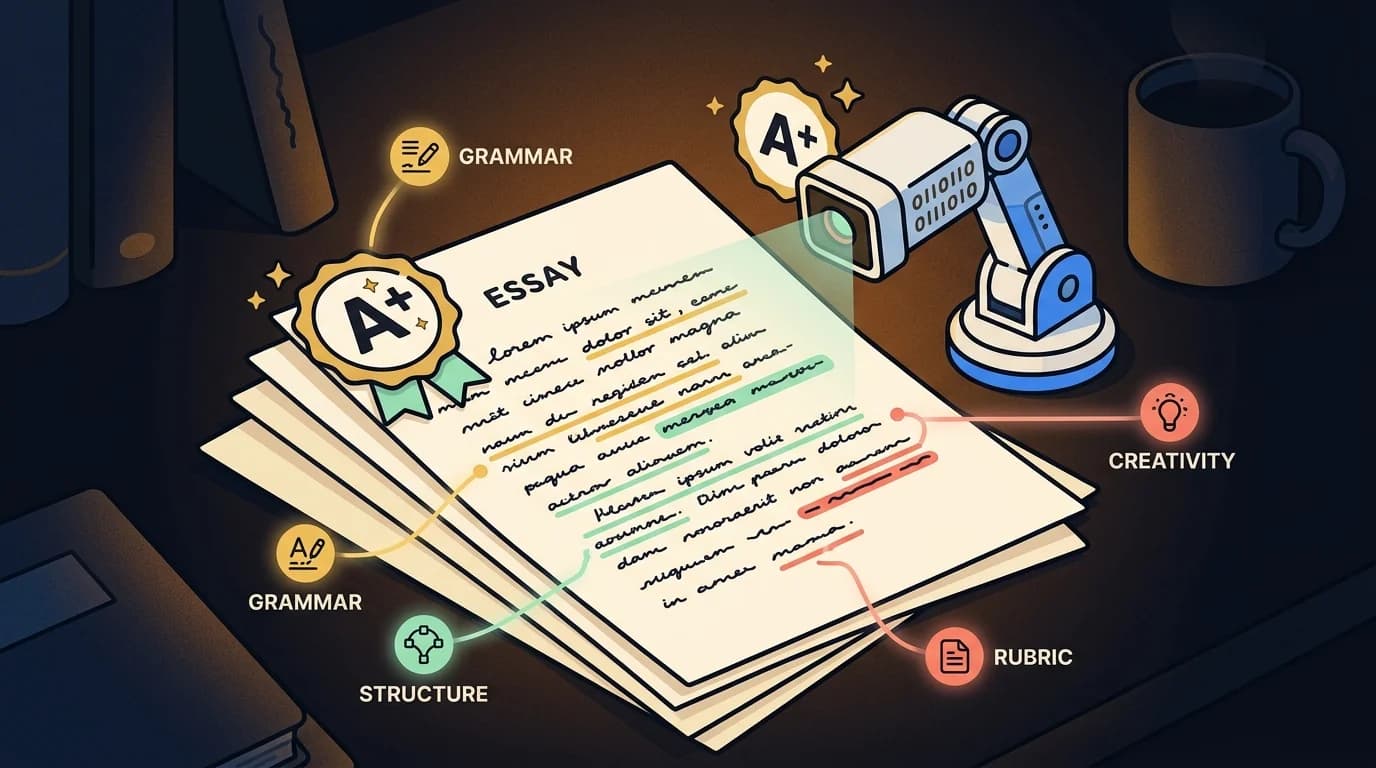
The categories that AI grading tools can assess reliably:
Grammar and mechanics — errors in sentence structure, punctuation, agreement, run-on sentences. All AI writing tools do this well. It's the most computationally straightforward aspect of writing evaluation.
Clarity and sentence-level style — whether sentences are easy to follow, whether transitions between ideas work, whether word choice is precise. More useful than grammar checking alone, but still surface-level.
Structural coherence — whether the essay has a clear introduction, body, and conclusion; whether each paragraph has a discernible topic; whether the argument progresses logically. AI tools can assess this with reasonable accuracy on well-formatted essays.
Rubric alignment — some tools accept specific rubrics and evaluate the essay against defined criteria. This is the most directly actionable feedback type for assignment work.
What AI essay graders cannot evaluate reliably:
Whether your argument is factually correct — an AI tool can assess whether your argument is clearly stated and logically structured, not whether the claims you make are accurate.
Depth of subject engagement — a marker who knows the field will recognise when an essay demonstrates genuine understanding versus surface familiarity. AI tools can't assess this.
Originality — AI tools tend to reward conventional essay structures. An unconventional argument that's well-supported may receive structural feedback that, if followed, would make the essay worse.
Best AI Tools for Getting Essay Feedback
ChatGPT (with specific prompting)
ChatGPT is the most versatile option for essay feedback because you can tell it exactly what kind of feedback you need. Generic prompts produce generic feedback. Specific prompts produce specific feedback.
Compare these:
Generic: "Grade my essay."
Specific: "Read this essay and identify: (1) the clarity of the thesis statement, (2) the three weakest points in the argument and why, (3) whether the evidence in each body paragraph directly supports the paragraph's claim, (4) any sentences where the reasoning is unclear. Be specific and direct."
The second prompt returns feedback you can actually act on. The first returns a brief summary and a score.
You can also paste in your assignment criteria or rubric and ask ChatGPT to evaluate the essay against specific requirements — "Does this essay answer the question as stated? What's missing?"
Best for: Students comfortable with prompting; substantive argument feedback; rubric-specific evaluation when you provide the criteria.
EssayGrader
EssayGrader is built specifically for rubric-based essay assessment. Teachers can define rubrics; students can use standard academic writing rubrics or input their assignment requirements. The feedback is more structured than ChatGPT's default output because it's organised around the rubric categories.
For students who have a clear rubric from their professor, this workflow produces actionable feedback. The tool evaluates the essay against each rubric dimension and explains where it falls short.
Best for: Assignment-specific feedback; students with a defined rubric; self-assessment before submission.
Grammarly (Premium)
Grammarly's premium tier evaluates style, clarity, engagement, and delivery alongside standard grammar checking. The feedback appears inline in real time as you write, which makes it more useful as a drafting tool than a post-writing grader.
What Grammarly doesn't do: evaluate argument quality. It assesses whether writing is clear and polished; it doesn't assess whether the reasoning is sound. A beautifully written essay with a weak argument will receive positive feedback from Grammarly.
Best for: Writing quality, grammar and style, real-time feedback while drafting.
Wordtune
Wordtune focuses on sentence-level rewriting rather than overall essay feedback. It suggests alternative phrasings for selected sentences, helping with clarity and variety. The overall feedback features are less developed than dedicated essay graders, but the rewriting suggestions are often more specific than Grammarly's.
Best for: Sentence-level revision; improving phrasing; students who know their argument is sound but want to improve how it reads.
Writing Centre / Peer Feedback (as complement)
Worth including because AI feedback, used in isolation, systematically misses things that matter. A writing centre consultant or well-briefed peer can assess:
- Whether the argument is actually persuasive to a reader
- Whether engagement with the subject material demonstrates genuine understanding
- Whether the tone and register are appropriate for the specific assignment type
The most effective pre-submission process: AI feedback for mechanics and structure, human feedback for argument quality and subject engagement.
How to Use AI Essay Feedback Productively
The students who get the most value from AI essay feedback use it as one input among several, not as the final word on their work.
Get specific feedback, not scores. A score tells you very little. "Your thesis is unclear because it doesn't specify the mechanism by which X causes Y" tells you something you can fix.
Separate feedback types. Mechanics (grammar, punctuation) and argumentation are different things that need different responses. Fix the mechanics; think critically about the argumentation feedback before acting on it.
Revise, then re-submit. The feedback loop should be: draft → AI feedback → revise → AI feedback again → submit. Checking only before the final submission limits the value.
Ask why, not just what. After receiving feedback that your paragraph structure is weak, ask the AI: "Why is this paragraph structure weak? What specifically is missing or misplaced?" The explanation usually generates more usable guidance than the initial identification.
Don't over-optimise for the AI. If you reorganise your essay to satisfy an AI's structural preferences, check that the result is actually better — not just different in a way the AI prefers. The measure is whether a human reader finds it clearer and more persuasive.
The Limits of AI Essay Grading
Understanding where AI tools fail helps you know when their feedback is reliable and when to be sceptical.
Discipline-specific norms: AI tools apply general academic writing standards. In some disciplines — philosophy, legal writing, literary criticism — the conventions are different and sometimes explicitly violate what general AI tools recommend. Know your discipline's standards before acting on AI suggestions that seem to conflict with what your professors want.
Argument truthfulness: AI can check argument logic (does the conclusion follow from the premises?) but not argument validity (are the premises true?). For any factual claim AI feedback implicitly endorses, verify independently.
Length and complexity: Very long essays may be processed inconsistently by some tools. If you're working on a long piece, break it into sections and evaluate each one.
For students who want to improve writing quality through the research and drafting phase rather than just before submission, building a strong understanding of your subject matter is the foundation. Cuflow's AI study assistant processes your course readings and notes, which is where the depth that drives strong essays originates.
Frequently Asked Questions
Is there an AI that can grade my essay for free?
ChatGPT (free tier) will provide essay feedback if you ask with a specific prompt. Grammarly's free tier handles grammar and basic style. EssayGrader has a limited free tier. For rubric-based feedback, the free options are more restricted.
How accurate is AI essay grading?
For grammar and mechanics, very accurate. For structural and argument feedback, approximately accurate on well-formatted academic essays. For subject-specific assessment, unreliable — AI tools can't assess whether your analysis is correct or demonstrates genuine subject understanding.
Can AI improve my essay grade?
Using AI feedback to improve grammar, clarity, and structure before submission will generally improve grades, particularly when those elements are explicitly assessed. Whether it improves grades significantly depends on whether argument quality — which AI evaluates less reliably — is the primary driver of your current grade.
Does using AI essay feedback count as academic dishonesty?
Using AI to check and improve your own writing is generally treated the same as using a grammar checker or writing centre — it's acceptable. Submitting AI-generated text as your own work is treated as dishonesty at most institutions. Check your institution's specific policy.
How do I prompt AI to give better essay feedback?
Include your assignment question, the rubric if you have one, and ask for specific rather than general feedback. Example: "Evaluate this essay against the following rubric: [paste rubric]. For each criterion, explain specifically where the essay meets the requirement and where it falls short. Be direct about weaknesses."
Summary
AI essay graders are most useful for mechanics, clarity, and structure feedback. For argument quality and subject-specific evaluation, they're approximate at best. The most effective pre-submission process combines AI feedback for technical aspects with human feedback — peer, writing centre, or professor — for argument and subject engagement.
ChatGPT with specific prompting is the strongest option for substantive argument feedback. EssayGrader is best for rubric-specific evaluation. Grammarly handles mechanics and style in real time.
For students whose grades are constrained by subject knowledge rather than writing quality, the lever that matters most is the depth of engagement with course materials — which AI study tools like CuFlow are built to support. See also: best AI essay graders for a wider comparison.