What Is GPA? A Complete Student Guide for 2026 (US, UK and Canada)

·9 min read
GPA stands for Grade Point Average. It's the standard numerical measure of academic performance used across US high schools, colleges, and universities — and increasingly referenced by institutions in Canada, Australia, and parts of Asia. If you're applying to college, graduate school, or a competitive job, your GPA matters. Understanding what it is, how it's calculated, and what counts as a good GPA helps you study smarter and set realistic goals.
How GPA Is Calculated
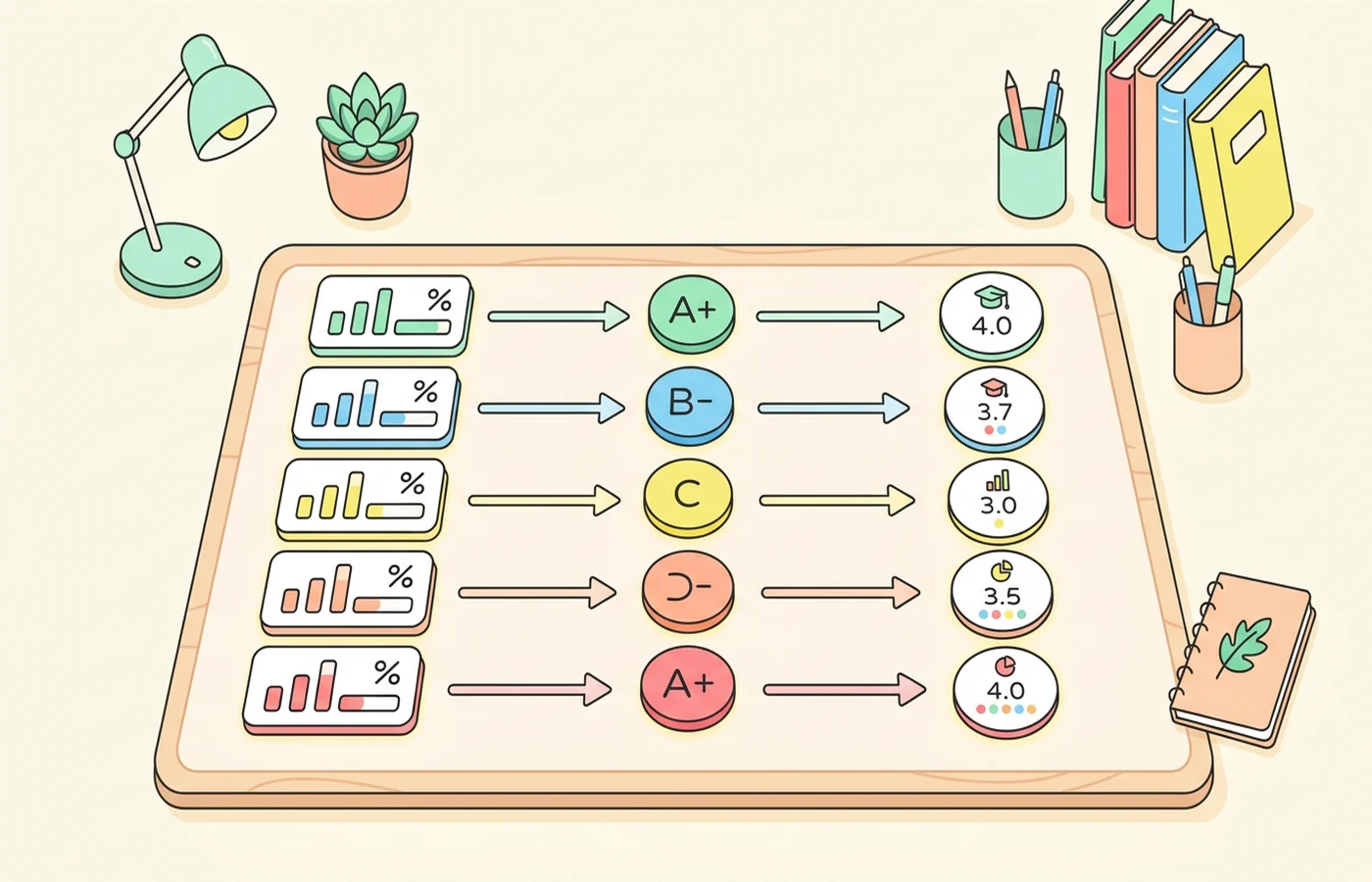
GPA is calculated by assigning each letter grade a numerical value (a grade point), then averaging those values across your courses, usually weighted by credit hours.
The Standard 4.0 GPA Scale
In the US, most institutions use a 4.0 scale:
| Letter Grade | Percentage | Grade Points |
|---|---|---|
| A+ | 97–100% | 4.0 |
| A | 93–96% | 4.0 |
| A− | 90–92% | 3.7 |
| B+ | 87–89% | 3.3 |
| B | 83–86% | 3.0 |
| B− | 80–82% | 2.7 |
| C+ | 77–79% | 2.3 |
| C | 73–76% | 2.0 |
| C− | 70–72% | 1.7 |
| D+ | 67–69% | 1.3 |
| D | 63–66% | 1.0 |
| D− | 60–62% | 0.7 |
| F | Below 60% | 0.0 |
Note: Some schools don't award A+ as a grade point above 4.0, treating A and A+ identically at 4.0.
Calculating Your GPA Step by Step
Your GPA is a credit-weighted average of your grade points.
Example:
- English Literature (3 credits) — A (4.0) → 3 × 4.0 = 12.0
- Mathematics (4 credits) — B+ (3.3) → 4 × 3.3 = 13.2
- History (3 credits) — B (3.0) → 3 × 3.0 = 9.0
- Biology (4 credits) — A− (3.7) → 4 × 3.7 = 14.8
Total quality points: 12.0 + 13.2 + 9.0 + 14.8 = 49.0 Total credit hours: 3 + 4 + 3 + 4 = 14 GPA: 49.0 ÷ 14 = 3.5
Most universities calculate your GPA automatically in their student portal. But knowing how it works helps you understand which courses are raising or lowering your average and where to focus your effort.
Weighted vs Unweighted GPA
This distinction matters most at the high school level.
Unweighted GPA uses the standard 4.0 scale regardless of course difficulty. An A in a standard class and an A in an Advanced Placement (AP) class both count as 4.0.
Weighted GPA gives extra points for more rigorous courses. AP classes, International Baccalaureate (IB) courses, and honors sections typically add 0.5 or 1.0 to the grade point. An A in an AP class might count as 5.0 on a weighted scale.
Most US colleges recalculate your GPA using their own unweighted scale when comparing applicants — so having a weighted 4.5 doesn't automatically impress admissions officers who will convert it back. What matters is both the GPA number and the course rigor on your transcript.
At university level, most institutions use unweighted GPA exclusively.
Cumulative vs Semester GPA
Semester GPA is your GPA for a single term — only the courses you took that semester.
Cumulative GPA is your overall GPA across all semesters. This is what transcripts, graduate applications, and employers typically reference.
One bad semester doesn't ruin a cumulative GPA permanently, but it takes more work to recover than most students expect. A single 2.0 semester on an otherwise 3.5 record pulls the cumulative down — and requires multiple high-performing semesters to bring it back up.
What Is a Good GPA?
"Good" depends on context.
High school:
- 3.5–4.0: Competitive for selective colleges
- 3.0–3.4: Solid for most colleges; consider safety schools
- Below 3.0: May limit options; supplementary materials (essays, extracurriculars) become more important
University (undergraduate):
- 3.7–4.0: Summa cum laude territory; competitive for top graduate programs
- 3.5–3.69: Magna cum laude at most schools; strong for most graduate programs
- 3.0–3.49: Acceptable for most graduate programs; competitive varies by program
- 2.7–2.99: Below average; some graduate programs won't accept below 3.0
- Below 2.5: May jeopardize academic standing; check your institution's minimum requirements
For employment: Many employers don't ask for GPA at all after you've had relevant work experience. Entry-level recruiting at investment banks, law firms, and consulting companies sometimes filters on 3.5 or 3.7+. Most other employers care more about internships, skills, and interviews.
GPA in the UK and Canada
United Kingdom
UK universities don't use GPA at all. The British degree classification system is entirely separate:
| Classification | Percentage Range |
|---|---|
| First Class (1st) | 70%+ |
| Upper Second Class (2:1) | 60–69% |
| Lower Second Class (2:2) | 50–59% |
| Third Class (3rd) | 40–49% |
| Pass | 35–39% (varies) |
For UK students applying to US graduate programs, you'll need to convert your degree classification to an approximate GPA. Most US graduate programs accept the WES (World Education Services) conversion, which typically maps a 1st to a 4.0 and a 2:1 to approximately a 3.3–3.7.
Canada
Canadian universities use a variety of GPA systems. Many use a 4.0 scale identical to the US system. Others use a 4.3 scale or a percentage-based system depending on the institution and province.
Common Canadian GPA scales:
- 4.0 scale (similar to US): Used by University of Toronto, UBC, McGill
- 4.3 scale: Used by some Ontario universities — A+ = 4.3, A = 4.0
- Percentage only: Some universities report grades as percentages without a GPA conversion
When applying internationally from Canada, WES or a similar credential evaluation service can provide a standardised conversion.
How to Improve Your GPA
Improving GPA requires more than studying harder. It requires studying smarter — specifically targeting the courses and topics where your grade points are weakest.
Prioritise high-credit courses. A 4-credit course affects your GPA more than a 1-credit elective. If you're choosing where to invest extra study time, focus on courses with the most credits.
Understand what's pulling your average down. Many students have a rough idea of their GPA but don't know which specific courses or assessments are dragging it down. Track this explicitly.
Use spaced repetition for recall-heavy subjects. Subjects like biology, history, and chemistry require you to retain large amounts of information across a semester. Spaced repetition — reviewing material at increasing intervals — is the most evidence-based method for long-term retention. Tools like CuFlow automate this: upload your lecture notes or textbook chapters and the system generates flashcards and schedules reviews based on what you're most likely to forget.
Start assessment prep earlier than feels necessary. The most common GPA mistake isn't effort — it's timing. Students who begin reviewing content three weeks before an exam consistently outperform students who start three days before, even when total study hours are similar.
Speak to your lecturer or TA. For courses where you're underperforming, a single office hours conversation often reveals exactly what the grader is looking for and what you're missing. Grades in many courses are recoverable if you identify the problem early.
GPA and Academic Standing
Most universities have minimum GPA requirements to maintain academic standing. Common thresholds:
- Good standing: 2.0 or above
- Academic probation: Below 2.0 for one semester
- Academic suspension: Below 2.0 for two consecutive semesters
Specific requirements vary by institution and often differ by program (law and medical schools typically require higher minimums). Check your institution's academic policies if you're approaching these thresholds.
Frequently Asked Questions
What is a 3.0 GPA equivalent to?
A 3.0 GPA is equivalent to a B average on the standard 4.0 scale — typically corresponding to grades in the 83–86% range. It represents satisfactory academic performance and meets the minimum requirements for most graduate programs, though competitive programs often expect higher.
Is a 3.5 GPA good for college?
Yes, a 3.5 GPA is considered a strong academic record for most US colleges. It corresponds to roughly an A-/B+ average and is competitive for most universities. For highly selective schools (top 20), a 3.5 is within the range but supplementary factors — test scores, essays, activities — carry significant weight.
Does GPA matter for jobs?
GPA matters most for entry-level positions at firms that use it as an initial filter — primarily consulting, investment banking, law, and competitive graduate programs. After your first job, GPA typically matters much less than experience and demonstrated skills. Many employers don't ask for GPA at all beyond entry-level hiring.
Can I raise my GPA significantly in one semester?
Yes, but recovery takes longer than most students expect. If your cumulative GPA is 2.5 over six semesters and you earn a 4.0 in your seventh semester, your new cumulative GPA is approximately 2.64 — a meaningful improvement, but not a full recovery in one term. Consistent performance over multiple semesters is the most reliable path.
What is the difference between GPA and CGPA?
CGPA stands for Cumulative Grade Point Average — it's the average across all semesters combined. GPA can refer to either a single semester's grade point average or the cumulative. In practice, when admissions offices and employers ask for your GPA, they mean your cumulative GPA.
How is GPA calculated for graduate applications?
Graduate programs typically calculate your undergraduate GPA from your official transcript. Some programs recalculate using only courses in your major. Some exclude early semesters (first-year grades). Check each program's specific policy — many graduate school websites specify how they evaluate transcripts.
Making the Most of Your GPA
Your GPA is a lagging indicator — it reflects what you've already done, not what you're capable of. The students who improve their GPA most effectively are the ones who track it course by course, understand exactly what's driving their current average, and invest effort proportionally.
If you're working to improve your academic performance, the combination of early preparation, targeted review, and tools that help you retain course material over time — rather than cramming the night before — produces the most consistent results. CuFlow's spaced repetition and performance tracking are built specifically for this kind of systematic improvement across a full semester.
Your GPA matters. But it's a measure of a process — and the process is something you can always improve.