
Spaced Repetition App: Which Type Actually Helps Students Remember More?

·5 min read
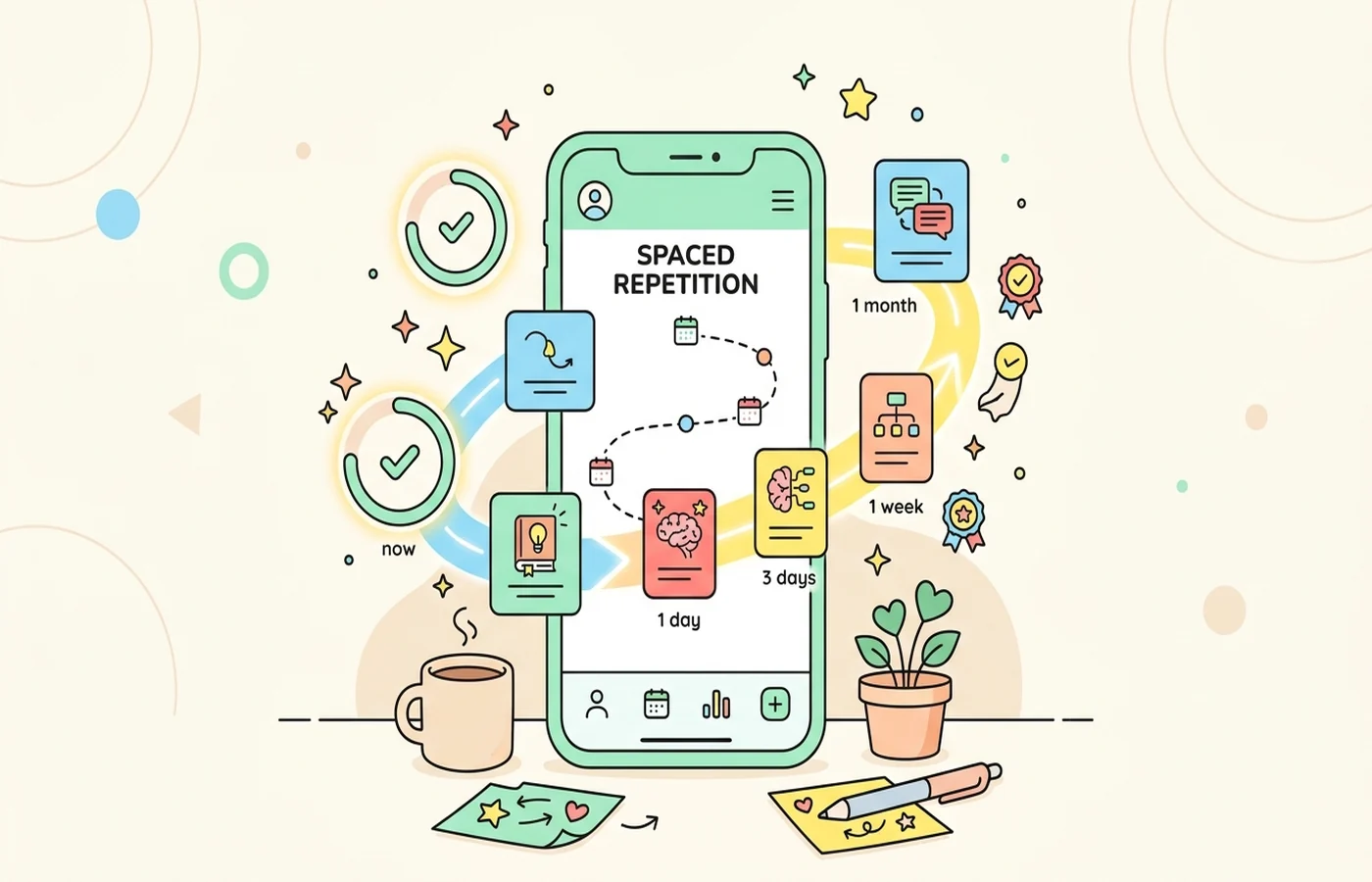
A spaced repetition app is one of the few study tools categories where the research and the marketing mostly agree: reviewing information at increasing intervals really does improve retention. The problem is that "spaced repetition" is now used to describe everything from serious memory systems to basic flashcard apps with a review button.
If you want a spaced repetition app that genuinely improves exam performance, the key question is not whether the app mentions memory science. It is whether it makes retrieval practice easy enough to sustain over time.
What a Spaced Repetition App Actually Does
Spaced repetition schedules review so you see information again just before you are likely to forget it. Instead of reviewing every flashcard equally, the system adjusts frequency based on difficulty and performance.
This is useful because forgetting is uneven. Some concepts stick immediately. Others disappear by the next day. A good spaced repetition system saves time by pushing easy material further out and surfacing weaker material sooner.
In practical terms, the best spaced repetition app should help you:
- review less often overall
- remember more over the long term
- focus on weak concepts instead of re-reading everything
What to Look For in a Spaced Repetition App
Fast card creation. If building the system is too much work, you will stop using it.
Good review UX. The review loop should be frictionless on both desktop and mobile.
Content flexibility. Students do not only study vocabulary. You may need definitions, formulas, processes, examples, or conceptual distinctions.
Source-based generation. The strongest tools generate cards from your notes, PDFs, or lectures rather than forcing you to type everything manually.
Performance feedback. You should be able to see where you are struggling and which topics need more attention.
The Best Options in 2026
1. CuFlow
CuFlow works especially well for students because it does not treat spaced repetition as an isolated flashcard feature. It starts with your actual study materials. Upload a PDF, lecture notes, or recorded content, and CuFlow generates notes, quizzes, and flashcards from that source material. Your review schedule then adapts based on how you perform.
That integration is important. A lot of students know spaced repetition works but never maintain it because card creation is too manual. CuFlow removes that setup burden.
It is particularly strong if your current workflow already involves study guide creation, AI quiz generation, or turning notes into study games.
2. Anki
Anki remains the benchmark for customisability. Its algorithm is proven, its card types are flexible, and the add-on ecosystem is huge. For medical students, language learners, and power users, it is still excellent.
The drawback is usability. Anki asks for more setup, more manual input, and more tolerance for a less polished interface than most modern students want.
3. Knowt
Knowt has become popular because it combines notes, flashcards, and review inside a cleaner interface than traditional SRS tools. It is easier to adopt than Anki and more directly student-oriented. The trade-off is less control.
Why Students Abandon Spaced Repetition
The theory is easy. The daily habit is not.
Most students stop using spaced repetition apps for one of three reasons:
Too much upfront work. If creating cards takes longer than studying from them, the system collapses.
The cards are bad. Poor flashcards test recognition rather than recall. That makes the app feel productive without producing much memory benefit.
The review load becomes intimidating. Miss a few days, and some apps punish you with a giant backlog. That creates avoidance instead of momentum.
This is why a source-grounded tool often works better than a pure flashcard app. If your cards are generated directly from your class materials, the system is easier to start and easier to trust.
How to Use a Spaced Repetition App Well
- Only add material you genuinely need to remember.
- Keep cards simple and testable.
- Review frequently, even in short sessions.
- Use quizzes and practice questions alongside flashcards.
- Update or delete weak cards instead of endlessly re-reviewing them.
Students who combine spaced repetition with active tools such as AI study guides and flashcard maker apps usually get more out of the system than students who treat flashcards as their only method.
Who Should Use a Spaced Repetition App?
Spaced repetition is especially valuable for:
- courses with large volumes of factual material
- cumulative exams
- terminology-heavy subjects like biology, law, and medicine
- students who forget material quickly after class
It is less useful as a standalone solution for essay-heavy subjects where argument practice matters more than isolated fact recall. Even there, though, it still helps with definitions, theorists, and core concepts.
FAQ
What is the best spaced repetition app for students?
For students who want a low-friction workflow, CuFlow is one of the best options because it generates flashcards from real study materials and ties review to quizzes and notes. For maximum customisation, Anki is still a top choice.
Does spaced repetition really work?
Yes. Spaced repetition is supported by decades of memory research. Its strength comes from revisiting information at increasing intervals and combining that timing with active recall.
Is a spaced repetition app better than re-reading notes?
For long-term retention, yes. Re-reading can help familiarity, but retrieval practice inside a spaced repetition app is usually much better for remembering material on exam day.